Betobeto-san
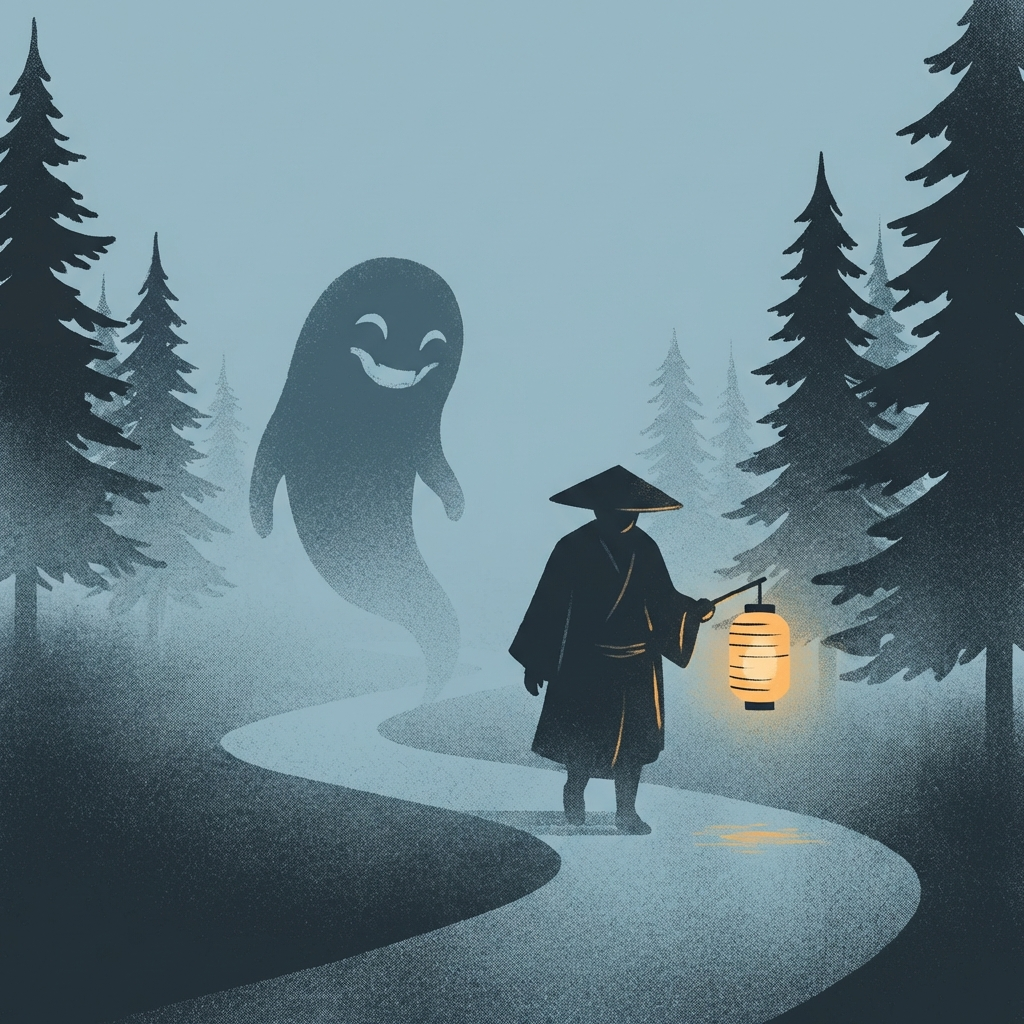
Betobeto-san べとべとさん
Betobeto-san (べとべとさん) is an invisible and harmless Yokai that embodies the universal fear of being followed on a dark, lonely path at night—a spirit of rhythm and etiquette.
Meaning and Origin
The name Betobeto is an onomatopoeia for the sound of footsteps, specifically the sound of wooden clogs (geta) echoing on a hard path. San is the polite honorific suffix. It translates to “Mr. Footsteps.”
Its origin is the rural folklore of Nara and Shizuoka. Unlike most Yokai that have a visual “monster” form, Betobeto-san was originally an Auditory phenomenon. It represents the way the brain interprets echoes and the sounds of shifting wind in the quiet of a midnight walk. It is a spirit born from the “Atmosphere of the Night,” a personification of the unsettling feeling that someone is just a few steps behind you, matching your pace exactly.
Characteristics
In traditional legends, Betobeto-san has No Form. It is purely a sound. It follows travelers on mountain paths or narrow village alleys. No matter how fast you walk, the “beto… beto…” sound follows. If you stop, the sound stops. If you run, the sound runs.
Modern art (famously by Shigeru Mizuki) depicts him as a round, translucent, or shadowy figure with a massive, friendly grin and no eyes. His primary characteristic is his Polite Persistence. He doesn’t want to hurt you; he simply has nowhere else to go and enjoys the company. He is said to be quite “sticky” (betobeto also means sticky in Japanese), meaning he is hard to shake off through physical speed alone.
Legends
The “legend” of Betobeto-san is actually a Practical Life Hack. There is a specific ritual to deal with him that has been passed down for centuries.
If you feel him following you, you must step to the side of the road and say: “Betobeto-san, please go ahead” (Betobeto-san, osaki ni okoshi). The moment you say this, the sound of the footsteps will pass you by and fade into the distance. Some legends say that if it is a particularly dark night, the invisible spirit might respond with a “thank you” or ask to borrow your lantern. It is a uniquely comforting Yokai—a reminder that even the things that haunt us might just be looking for a bit of politeness and a clear path forward.