Karakasa-kozō
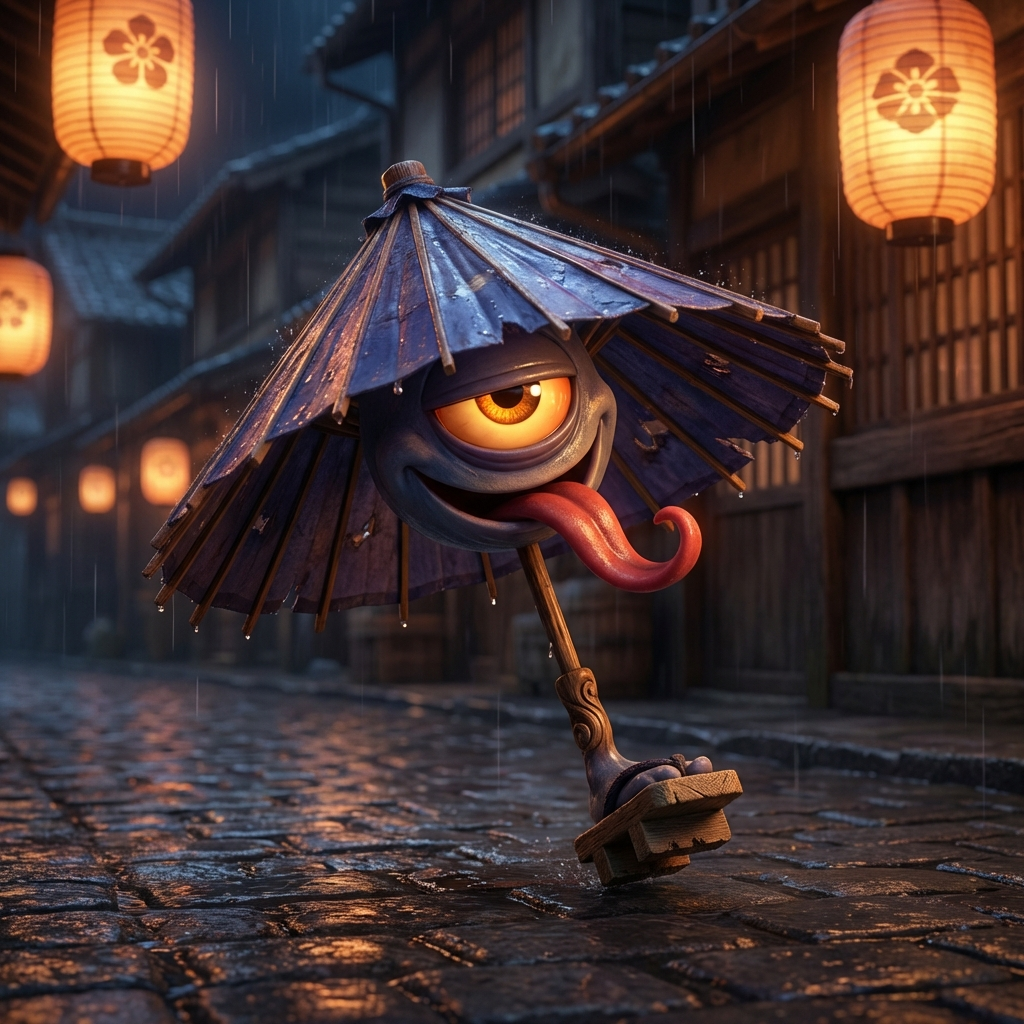
Karakasa-kozō 唐傘小僧
Karakasa-kozō (唐傘小僧), the “Umbrella Boy,” is perhaps the most beloved and recognizable of all Tsukumogami—a playful spirit that turns a rainy-day necessity into a hopping, tongue-wagging prankster.
Meaning and Origin
The name means Kara (China/Foreign), Kasa (Umbrella), and Kozō (Young monk or boy). It translates to “The Chinese-Umbrella Priest-Boy.”
Its origin is the Edo period’s explosion of Yokai art. Unlike the ancient monsters of legend, Karakasa-kozō is a purely artistic invention of the Edo ukiyo-e artists, who wanted to create a spirit that was more fun than frightening. He is a Tsukumogami born from an oiled-paper umbrella (Karakasa) that has served its owners for many years. He represents the Domestic Supernatural—the idea that the everyday objects in our lives are filled with a hidden, whimsical energy that only comes out when we aren’t looking.
Characteristics
Karakasa-kozō is iconic: he is a folded paper umbrella that stands on a single human leg (formed from the umbrella’s handle). He has one large, bulging eye in the center of his paper “face,” and a long, wet tongue that is almost always sticking out. Many depictions also show him with two small human arms.
His primary characteristic is his High-Energy Prankishness. He doesn’t bite or curse; instead, he hops through the rain on his single wooden leg, sneaking up on humans to give them a big, oily lick with his tongue or to suddenly expand his umbrella-wings to startle them. On windy days, he is said to catch the breeze and fly through the air like a kite, laughing in a voice that sounds like the rustling of paper. Despite his weird appearance, he is considered a “lucky” Yokai that brings a sense of life and joy to old storage sheds.
Legends
While there are few “epic” myths about him, he is a staple of the Night Parade of One Hundred Demons. One local folk story tells of a village where it rained for forty days. Every night, the villagers would see a strange, one-legged spirit hopping across the puddles.
At first, they were terrified, but they realized the spirit was actually protecting travelers. When a person was caught in the mud, the Karakasa-kozō would hop over and offer its own paper canopy as cover, sheltering them until the worst of the storm passed. When the sun finally came out, the spirit vanished into a pile of regular umbrellas. This legend suggests that even “scary” Yokai can be friends to humanity if they are treated with the respect due to a loyal tool.