Kiyomori Seeing Skulls
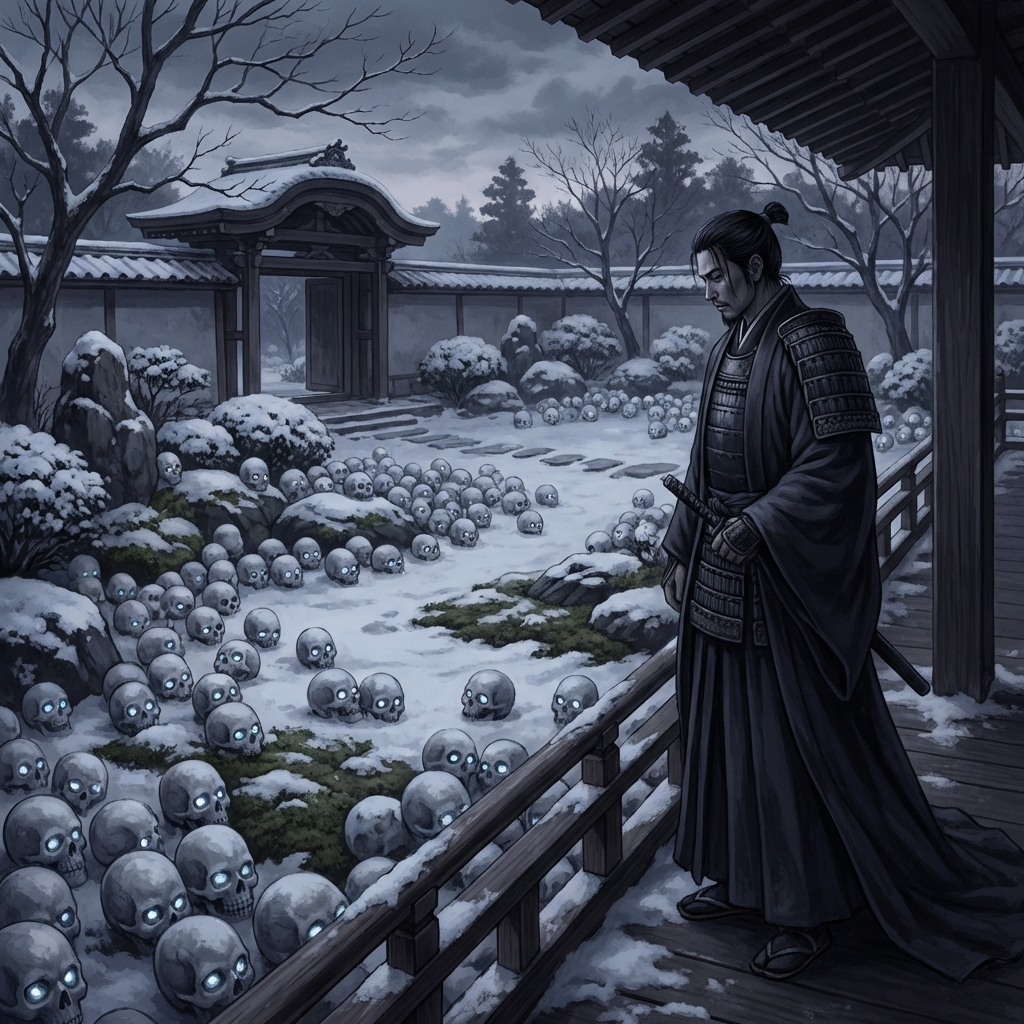
Kiyomori Seeing Skulls 平清盛怪異を見る
Kiyomori Seeing Skulls (平清盛怪異を見る) is a haunting episode from Japanese history that depicts the internal psychological collapse and karmic punishment of the dictator Taira no Kiyomori.
Meaning and Origin
The title referes to a specific hallucination experienced by Taira no Kiyomori (1118–1181), the head of the Taira clan who dominated the Imperial court through violence and intimidation.
The origin of this legend is the Heike Monogatari (The Tale of the Heike). As Kiyomori reached the height of his power, he began to suffer from a mysterious “fever of the soul.” He had ordered the deaths of countless enemies and even burned down sacred temples in Nara. The legend represents Karmic Retribution (Gōpō)—the Buddhist belief that the blood you spill will eventually come back to haunt your vision. It is the personification of the Guilt of a Tyrant.
Characteristics
The “Yokai” in this legend is the Skull-Vision. Kiyomori is described as looking out into his snowy garden and seeing the rocks, trees, and lanterns transform into human skulls.
The most terrifying version of the vision involves the skulls merging together. Thousands of small skulls are said to have rolled together like waves in the sea to form a single, colossal skull the size of a hill. This “Mega-Skull” had thousands of blinking eyes that glared at Kiyomori with a look of pure, concentrated hatred. Kiyomori’s primary characteristic in this moment was his unyielding arrogance; he did not look away, but stared back at the horror until it vanished.
Legends
The legend states that shortly after this vision, Kiyomori’s mysterious fever grew so intense that no water could cool him. Even as he lay on his deathbed, people said the water in his bath would boil and turn to steam the moment it touched his skin.
His death was seen as a warning to all future rulers: even the most powerful man in Japan cannot hide from the ghosts of his victims. The scene became a masterpiece subject for ukiyo-e artists, most notably Tsukioka Yoshitoshi, who portrayed the snowy garden filled with spectral skulls. It remains one of the most powerful visual metaphors for a “Haunted Conscience” in world literature.