Mokumokuren
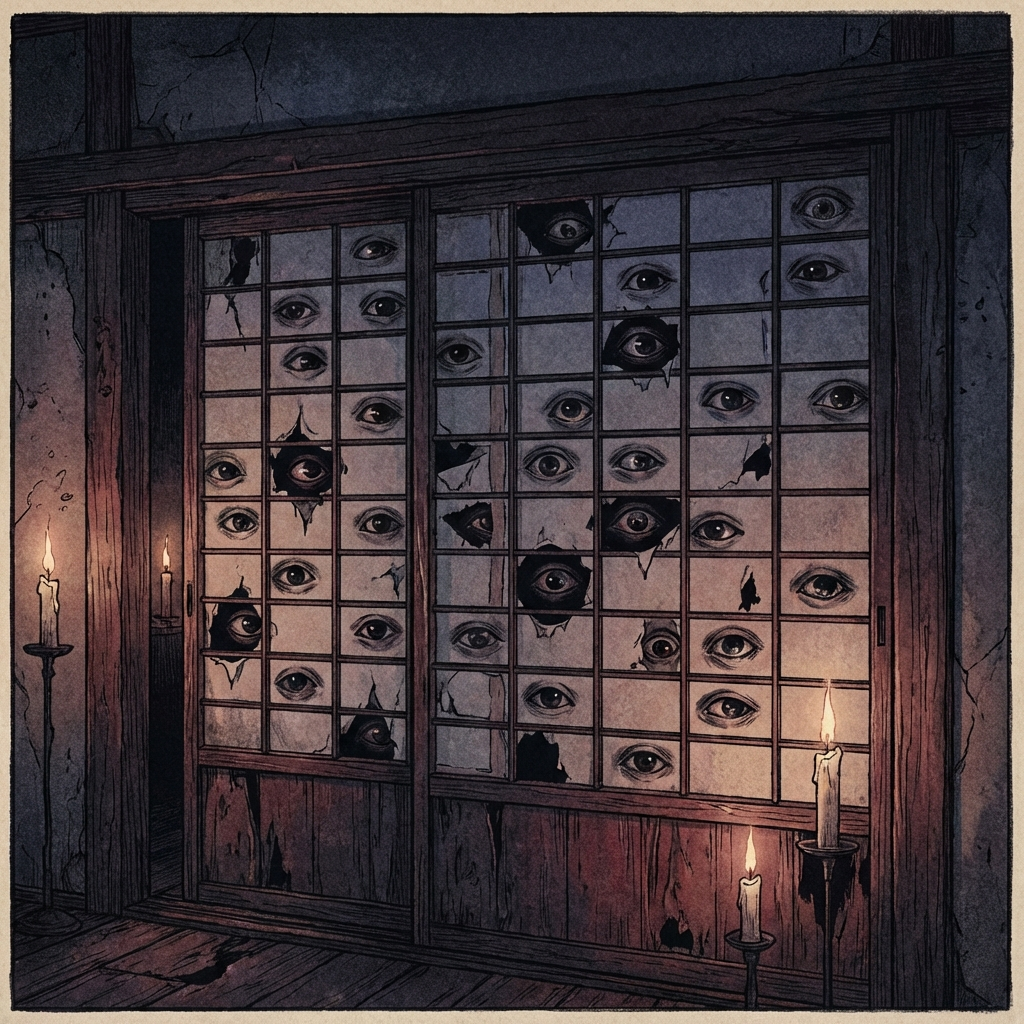
Mokumokuren 目目連
Mokumokuren (目目連), the “Many Eyes,” is a quiet but deeply unsettling spirit that manifests in the paper screens of neglected homes, reminding the inhabitants that even the walls have eyes.
Meaning and Origin
The name means Moku (目 - eye) and Ren (連 - succession or continuous). It translates to “eyes following eyes.”
Its origin is the Edo-period artist Toriyama Sekien, who first illustrated the spirit in his collection Konjaku Hyakki Shūi. Unlike many Yokai that are ancient monsters, Mokumokuren is a Tsukumogami—a household object that has gained a spirit after 100 years. Specifically, it arises from the Shōji (sliding paper doors) that have been allowed to develop holes and tears without repair. It represents the Shame of Neglect and the uncanny feeling of being watched in one’s own home.
Characteristics
Mokumokuren is not a singular creature, but a collection of countless human-like eyeballs that appear within the gaps of torn paper screens. They do not have bodies, only the eyes themselves, which blink and stare with a cold, unblinking intensity.
Its primary characteristic is its Silent Watchfulness. It does not attack or scream; it simply exists. However, its presence is said to be a drain on the spiritual energy of the home. If a person tries to sleep in a room filled with Mokumokuren, they will wake up feeling exhausted, as if their very privacy has been “consumed” by the staring eyes. To remove them, one does not need a priest or a sword—only a sheet of fresh paper and a bowl of starch paste to Repair the Screen.
Legends
One famous legend tells of a stingy traveling merchant who sought to save money by staying in a dilapidated, “haunted” mansion. He awoke in the middle of the night to see the walls covered in hundreds of eyes.
Instead of being terrified, the merchant was a man of cold logic. He took a small knife and carefully plucked out the eyeballs from the paper screen. He put them in a jar and sold them the next day to a local eye doctor as “spectral medicine,” making a tidy profit from the haunting. This story is uniquely Japanese in its humor, suggesting that if you are brave and clever enough, you can even turn a haunting into a business opportunity.