Nurikabe
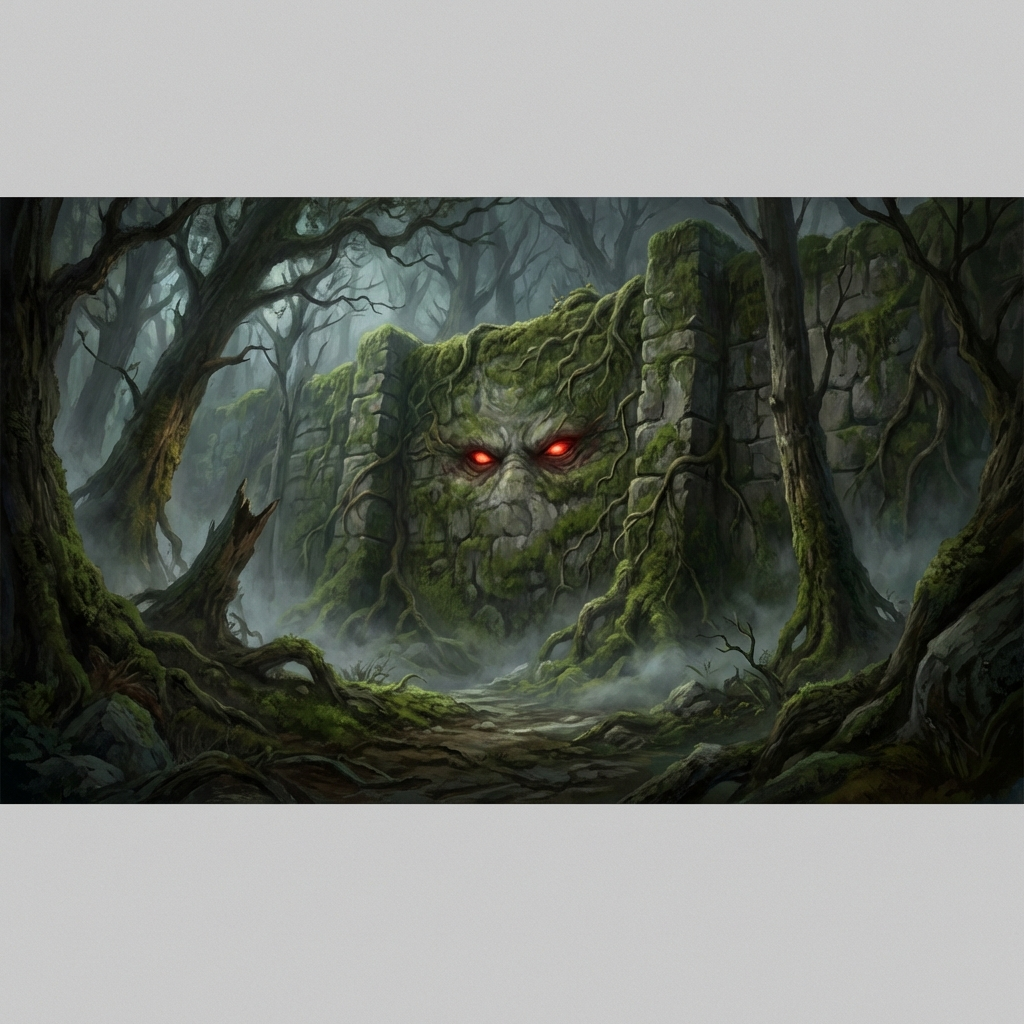
Nurikabe 塗り壁
Nurikabe (塗り壁), the “Plastered Wall,” is one of Japan’s most frustrating and mysterious spirits—an invisible, immense barrier that suddenly appears at night to block a traveler’s path.
Meaning and Origin
The name means Nuri (Plastered/Painted) and Kabe (Wall). It translates to “The Plastered Wall Spirit.”
Its origin is traditional folklore from the coastal regions of Kyushu, especially Fukuoka. Originally, Nurikabe didn’t have a visual form; it was an invisible phenomenon that travelers encountered on dark mountain passes. It was the folk explanation for the feeling of being “lost in the dark” or “walking in circles.” Modern visual depictions—a flat, rectangular wall with tiny arms and eyes—were popularized by the manga artist Shigeru Mizuki, who claimed to have encountered a real Nurikabe during his time as a soldier in World War II.
Characteristics
In its traditional form, Nurikabe is Invisible and Infinitely Wide. No matter how far a traveler walks to the left or right, the wall extends further, preventing them from bypassing it. It is also said to be too tall to climb and too solid to push through.
Its primary characteristic is its Silent Obstruction. It does not attack or make a sound; it simply “is.” It is a master of psychological warfare, making the victim feel that the world has ended and there is nowhere left to go. However, the Nurikabe has a secret weakness: if a traveler taps the bottom-left corner of the wall with a stick (or their foot), the spirit will lose its focus and vanish instantly, allowing the path to open again. It represents the “random obstacles” of life that can be overcome with a single, precise action.
Legends
One famous legend tells of a group of villagers who were trying to deliver medicine to a neighboring valley. As they reached a narrow pass, they suddenly hit an invisible barrier. They pushed and shoved, but it was like hitting a mountain of solid ice.
Panic began to set in as the sun went down. One of the elders remembered the old tales and told the youngest boy to sweep his walking stick across the ground on the left side. The moment the stick struck the invisible base of the wall, there was a sound like a heavy sigh, and a sudden rush of cold wind. The path was clear. The villagers realized that the Nurikabe hadn’t been trying to kill them, but was simply “standing” in that spot. To this day, the legend of Nurikabe is used as a metaphor for the invisible barriers we face in our daily lives—reminding us that often, the biggest wall is only as solid as our own fear.