Yoshihira at the Nunobiki Falls
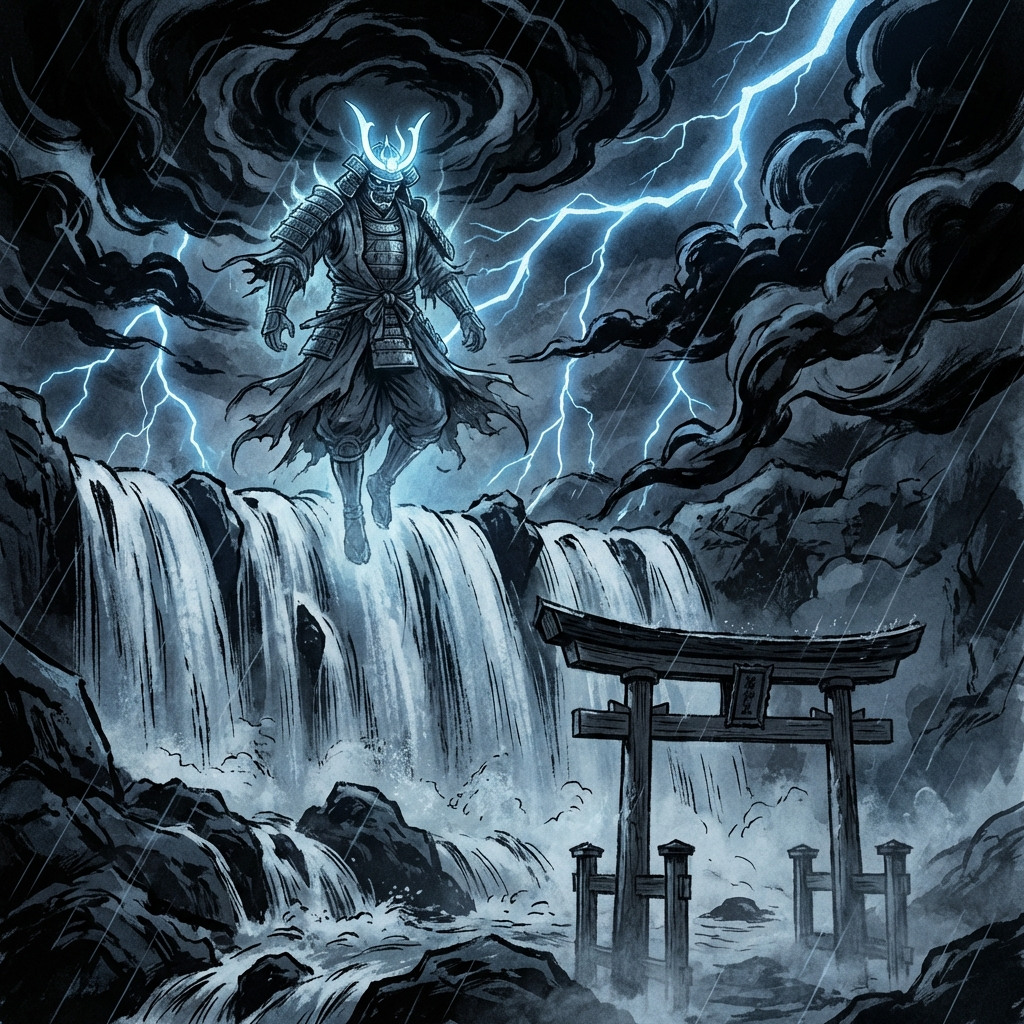
Yoshihira at the Nunobiki Falls 布引の滝の義平
Yoshihira at the Nunobiki Falls refers to the terrifying manifestation of Akugenta Yoshihira (Minamoto no Yoshihira), a fierce warrior whose spirit returned as a thunder god to claim revenge against those who betrayed him.
Meaning and Origin
Yoshihira (义平) was the eldest son of Minamoto no Yoshitomo and a commander during the Heiji Rebellion (1159). His nickname, Akugenta, means “Evil Genta,” denoting his savage bravery rather than moral wickedness.
The origin of this legend is the Heiji Monogatari (The Tale of Heiji). After his father’s defeat, Yoshihira was captured and sentenced to death by his rival, Taira no Kiyomori. He was executed by a low-ranking official named Nanba Jirō. Before his head fell, Yoshihira swore that he would return as lightning and strike his executioner dead. The setting, Nunobiki Falls (布引の滝) in Kobe, is one of Japan’s most sacred waterfalls, traditionally seen as a gateway between the human and spirit realms.
Characteristics
As a Yokai or Onryō, Yoshihira is depicted as a Thunder Demon. In ukiyo-e prints, he is shown appearing amidst black storm clouds and jagged bolts of lightning. His face is twisted in eternal rage, and his hair flies wildly like flames.
His primary characteristic is Control over Atmospheric Fury. Unlike animalistic spirits, he is a “Historical Onryō” (Vengeful Spirit), meaning his power is fueled by a specific grudge. He represents the Inevitable Karma of the warrior class—no act of betrayal goes unpunished by the spirits of the slain.
Legends
The central legend takes place at Nunobiki Falls, where Nanba Jirō and Taira no Kiyomori were visiting. As they admired the beautiful, cloth-like cascade of water, the sky suddenly turned black.
A terrifying roar echoed from the waterfall, and the ghost of Yoshihira appeared, riding a bolt of lightning. Before anyone could react, a massive lightning strike hit Nanba Jirō, burning him to a cinder instantly. Taira no Kiyomori narrowly escaped, but the sight of the vengeful warrior haunted him for the rest of his life. This legend cemented the idea that a truly powerful warrior’s “Will” is stronger than death itself, capable of commanding the very forces of nature to achieve justice.